How The Money Works
A Nuts & Bolts Post
Hey friends!
It's been a while since I did a this is how it works post and today I'm going to do one about money–one of my favorite topics! Years ago, I did an interview with Laura Portwood-Stacer of Manuscript Works–who all you academic writers out there should know about–about money and you can read it here. We talk about real numbers from real book deals and it's great. Laura is the best.
Today, though, I thought I'd go back and give everyone an overview of how money works in traditional publishing because everyone can use a refresher. By the end of this newsletter, you'll be able to understand every bold -aced word in the following (fictional) paragraph. Let me say it again. This is now TRADITIONAL publishing works. Not self-publishing, hybrid, or vanity publishing. The number one way to tell the different between traditional publishing and any other form is how the money flows. In traditional publishing, the money flows from
PUBLISHER --> AGENT --> AUTHOR
The author does not pay the agent or the publisher directly in traditional publishing. You do not write your agent a check, ever. Anything else is not a traditional publishing deal.
But, moving on. Let's look at this example I just made up.
Betty got a new book deal! The advance for her new science fiction memoir is $20,000, payable in halves. She earns standard royalties of 10% of the hardcover price of $28.99. But she won't see more money beyond her advance until she earns out. Her agent takes a 15% commission and the checks will come to her through her agent. Luckily, her agent only sold North American English rights, so she might see some extra money through subrights sales. Everyone agrees it's a nice deal.
Let's start at the top!
Advance: The advance is the money the publisher pays you in exchange for the right to print, distribute, and sell your book. This will be limited to certain formats (hardcover, paperback, ebook, audio, etc) and territories (the US? the World?) and languages (English? Spanish? Translations?). We'll get to those other details in a minute but your advance is the number people say when they say I got a six figure book deal. That would be $100,000+. I wish you all six figure deals. The overwhelming majority of book deals are not six-figures and there is no statistical average book deal for all traditionally published books. It varies widely by genre and then within that book-to-book and author-to-author. Your friend might have gotten a $50,000 book deal for her dragon book but that doesn't mean you will get $50,000 or even $25,000 for your dragon book. Her book is her book and your book is your book and comparison is the thief of joy.
Payout: The publisher will pay you said advance in chunks, tied to different milestones in the publishing process. The agent's goal is to get as few chunks as possible. You'll get one chunk after the contract is signed by all parties, known as the signature payment. You'll get another chunk after you turn in the book and it goes through the whole editing process, called delivery & acceptance. (That's one payment with two names.) You may then get another chunk on the publication of your book. Guess what that's called? (A publication payment.) Betty will be getting two checks for $10,000 each, minus commission, upon signature and delivery & acceptance. That math looks like this:
$10,000 x 15% = $1,500
$10,000 -$1,500 = $8,500
Betty gets a check for $8,500 and Betty's agent keeps $1,500 as commission.
Your advance might be split up into further chunks, depending on your book and what goes into it. If you are writing a graphic novel, you might get a sliver of money when you turn in the pencil stage and then another when you delivery the full inked and lettered manuscript. You might get a payment when you turn in half your book (whatever kind of book it is) and then the rest when you turn in the whole thing. Some books, especially those with a higher advance amounts, might have a post-publication payment anywhere from six to twelve months after first publication. That latter payment may also be tied to a paperback publication. How ever your advance is sliced and diced, it may be called paid in halves, thirds, quarters, or more. The payments may be equal, or they may vary depending on what's being delivered. Your payout won't be the same as your friend's because you aren't writing your friend's book.
Royalties: The publisher will pay you a percentage of each book sold, called royalties. This rate varies depending on the publisher, the book's audience (adult royalties are different than kids book royalties), the format (hardcover, paperback, etc), and a lot of other things. There are several pages of the different royalty rates and what they apply to in the final contract. When most people talk about royalties and include a percentage, they're talking about the hardcover royalty rate (or maybe paperback, but usually hardcover) on the retail cost of the book. Some royalty rates are calculated on the net cost (retail - wholesale) but we won't get into that right now. In the above paragraph, Betty is earning 10% of the retail price of the hardcover book, which costs $28.99. That means she earns $2.89 every time a hardcover book sells. But she doesn't get a series of $2.89 checks in the mail. Those royalties accrue in an account and when it exceeds the advance amount, that's when Betty has earned out and then she will start receiving royalty payments. Royalties are paid out to authors twice a year, and that's outlined in the book contract. If you don't earn out your advance, you don't owe the balance back to the publisher. That's why it's called an advance, because the publisher is giving you upfront the money they think you'll earn in royalties and taking on the risk in case you don't.
Commission: Literary agents work on commission. (They may be paid a salary or some other payment structure by their agency, but that's not what we're talking about here.) When they sell your book, they get fifteen percent (15%) of all the money your book makes over time. That means 15% of the advance, 15% of the foreign rights if the agent sells them directly, 15% of the movie deal and 15% of the royalties, if any. Typically, the book contract tells the publisher to pay the agency the author's earnings, the agency takes 15%, and then the agency pays the author the balance. Forever and ever until the book doesn't earn any more money. Even if you change agents. If the agent sold the book, they are due their commission. This is how they pay their bills. In some cases, the book contract tells the publisher to pay the agency 15% and send the rest to the author. Both are fine. Usually an agency is set up to do it one way or the other, because otherwise it's very confusing who gets what slice of which money.
Subrights: is short for subsidiary rights, and these are basically all the different ways your book can be published, sold, made, and distributed and who has the rights to do those things. Examples of subrights are: audio books, film/tv rights, translation rights, video game/app/software rights, graphic novel rights (if the book isn't already a GN), merchandise (i.e. t-shirts and notebooks and such), limited/special editions (i.e the really really fancy ones you see these days), theme parks (yes), etc. These are all outlined in your contract, and there are even provisions for the stuff that hasn't been invented yet. Each format has its own royalty rate and/or it's outlined in the contract how you and the publisher split any income. For example, if your US publisher has translation rights, that means they get to try to sell it in other countries in languages other than English and they will split the money with you 75/25 in your favor. These splits vary but they are always in your favor or equal to the publisher. If you control the translation rights, your agent will try to sell those rights for you, possibly through their foreign co-agents, and you get all the money minus commission. It goes straight to you when it's paid, and not through your royalty account. When there's a foreign co-agent involved, commission rates usually go up to 20%, because your agent and the co-agent split it 10%/10%. Your agency agreement will outline all this.
A Nice Deal: Ever see people say someone got a nice deal or a good deal or a major deal and you feel like it's some code you don't know? That's because it is. When agents and editors post deals on PublishersMarketplace.com, they reference this nice/good/major language that the site came up with. Here's a key:
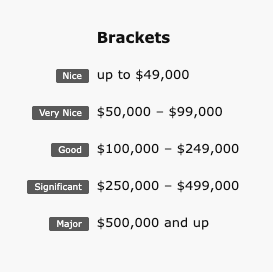
It's not any deeper than that. It's just something they made up twenty years ago. I highly recommend a subscription to PubMarketplace and to their newsletter Publishers Lunch. And they don't even pay me to say that.
Did you get all that? See? Your teacher was right that you would end up using algebra in real life one day.
Let's review. The publisher gives you an advance and you're paid out in installments. Once you get all the installments, that's most often all the money you're going to get for your book. As your book sells, including all income from subsidiary rights sales that your publisher controls, your advance account fills up, and when it reaches your advance amount, you then get paid royalties, according to the schedule outlined in your book contract (twice a year most often).
Here's what the math looks like to figure out royalty income. Let's pretend we're dealing with a 10% royalty on the retail cost of the book at $28.99, and you got a $20,000 advance.
$28.99 x 10% = $2.89/book
$20,000/$2.89 = ~6920 books
So you'd have to sell about 7000 books to earn out a $20,000 advance. In the grand scheme of things, that's a not-impossible goal! But also, your royalty account will fill up in different ways, at different rates, depending on how your book sells in different formats. Audiobook royalties are different from paperback royalties are different from ebook royalties are different from the royalties you earn when you get a $2.99 Kindle deal (high-discount royalties) so the numbers you do to guesstimate anything on your end will be rough figures. Your royalty statement will have the real numbers.
I'll say it again: if you don't earn out your advance, you don't owe the publisher the money back. I get asked all the time if it's "better" to take a big advance with no chance of earning out or a smaller advance with a better chance of earning out and my answer is always take the money and run. If you are in a position where you don't need to take the money and run, sometimes it can be advantageous to an overall career to take a medium advance and get closer to earning out but tbh, everyone mostly takes the big advances when they are offered. What you do in your case will be what's best for you. When you get a big advance, your next one will not automatically be that big, unless your book does really, really well. Your first advance does not become the floor for all advances to come, unfortunately. Once you have a book out, that book's sales count as your track record and the publisher considers those numbers when they offer for your next book (usually in the same/similar genres. They're not looking at your picture book sales to predict how your adult novel will sell).
Money can be scary to talk and think about. But I LOVE talking about money, and that's why I'm an agent. It's my job to talk about money. I don't, however, have any control over what publishers give my clients as an advance. I can send the right book to the right editor and pitch it in the best way but I can't say give us X dollars or we walk unless we are 100% prepared to walk. I can ask for more and sometimes get it, but I can't force a publisher to give me specific dollars for a specific author. Would that it t'were true. If I have a particularly big book/client, I can set a floor for an auction, or say we really need X amount to go forward, and sometimes I can get that, but it's because of the leverage I have with the big book/author. Any agent who promises you a specific dollar amount is not trustworthy, in my book. If I could fully control how much money my clients made I would have six wonderful clients who got a million dollars a year each and I would work like 1 hour a day and read in a hammock all the other hours. As you can see, that's not how it works for me.
I am proud of you for sticking through a whole newsletter about MATH in the summer. You've done your homework for today, and now you can go out and play.
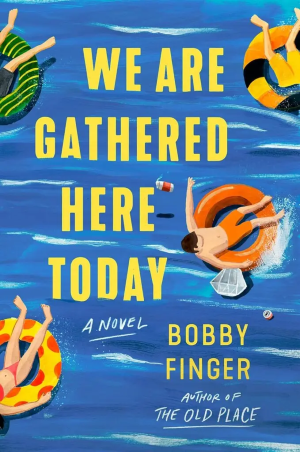
Out today! Happy book birthday to Bobby Finger for his THIRD novel: WE ARE GATHERED HERE TODAY! It's about when the queer table at a Texas wedding stops being polite, and starts getting real. It is funny and heartfelt and perfect for the beach. The New York Times agrees!
XO$XOX$XO$XO$,
Kate
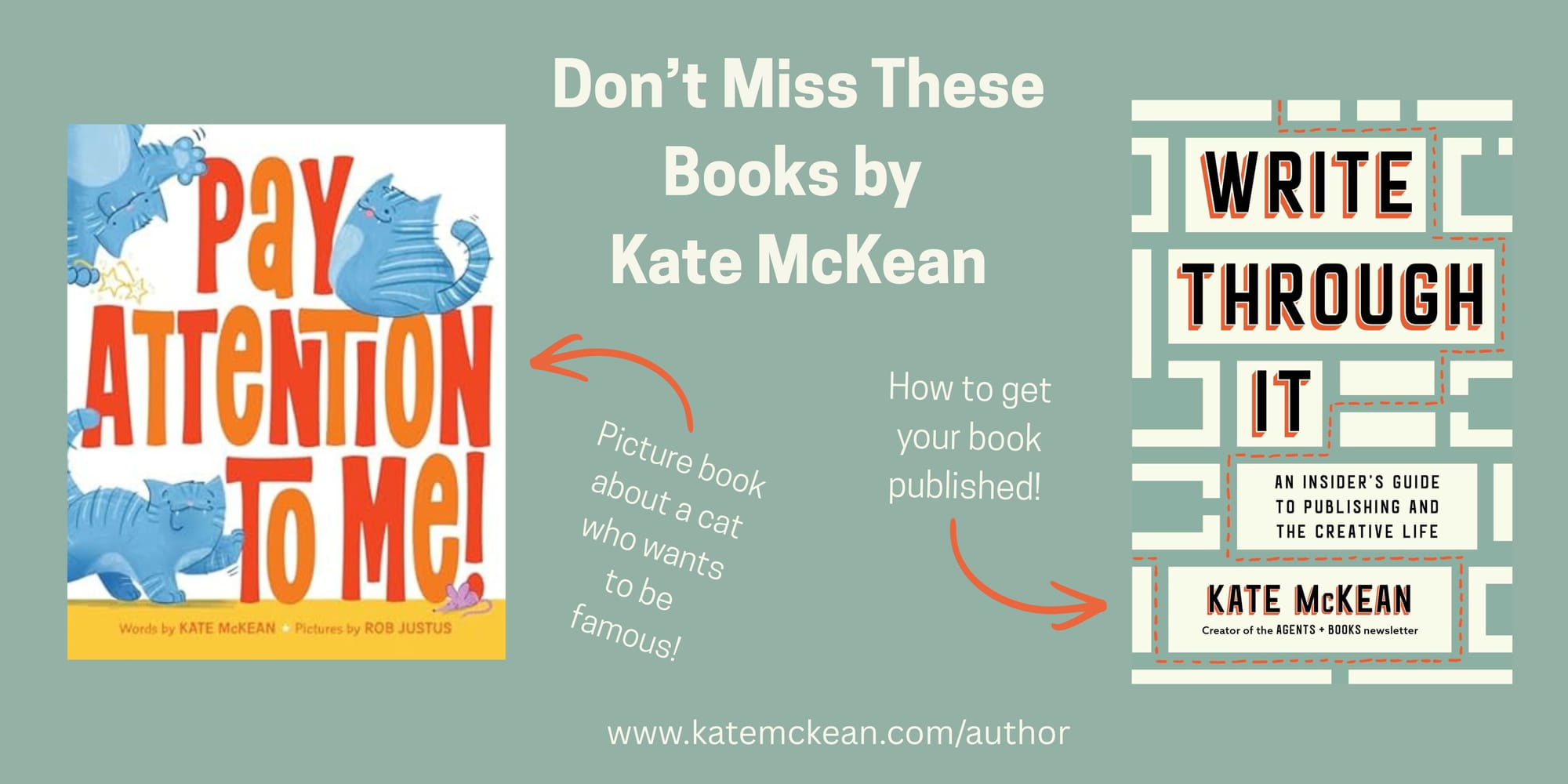

Who am I and what is this? This is Agents & Books, a twice-weekly newsletter about writing, publishing, and the creative life. I've been an agent for almost 20 years, most of it at the Howard Morhaim Literary Agency, and I'm the author of two books: Write Through It: An Insider's Guide to Publishing and the Creative Life (Simon Element, 2025) and a picture book called Pay Attention to Me!, with illustrations by Rob Justus (Sourcebooks, 2026). If you haven't already, become a subscriber today. $5 a month or $50 a year. Same price since 2019!
Comments ()