How To Ask For a Blurb
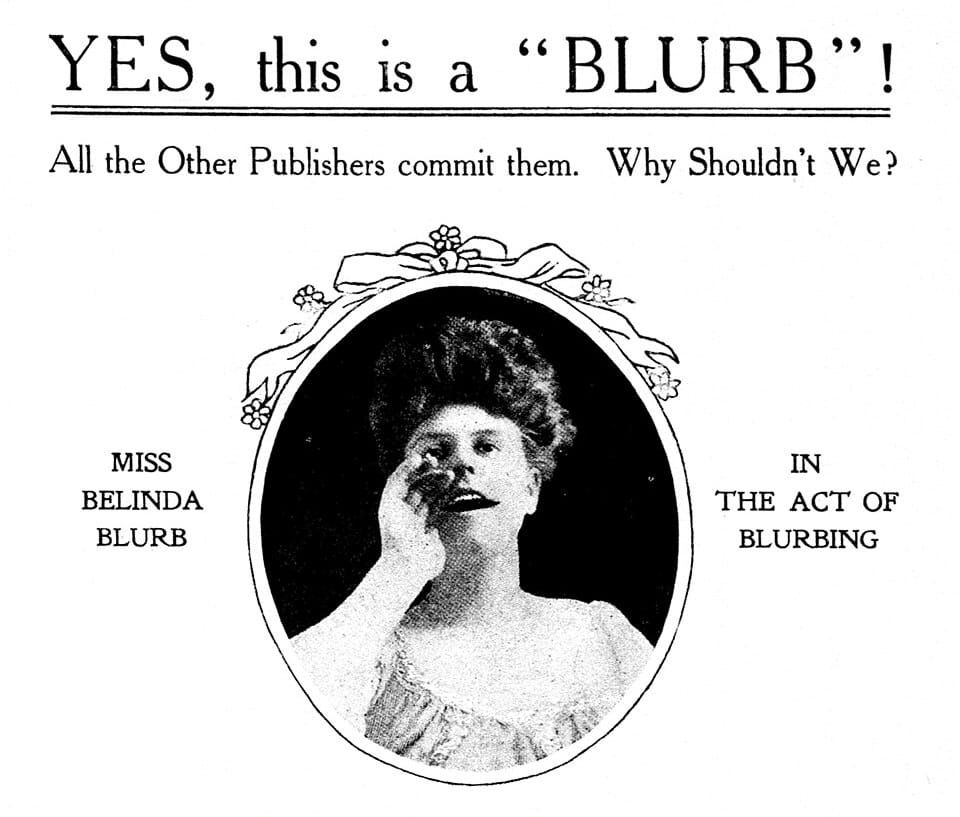
All the other publishers commit them
Hello friends!
I have a nuts & bolts post for you today, one I hope will come in handy at some point in your career, and an update on this post I wrote a few years ago, now with a sample letter for asking for blurbs. But first:
What's a blurb?
A blurb, in this context, is an endorsement for a book by a trusted or well-known source. For example:
"This book is a tour de force," Ms. Famous Writer, author of the New York Times Best Seller That Book Everyone Read.
That's it. That's a blurb. Blurb has an interesting history as word, according to the wikipedia page here. It's worth a read!
Blurb can also mean the short summary on the back of a book, or a short pitch for a book. But like with all words in the English language, we will use context clues to figure out which we're talking about. Today we're talking about an endorsement.
What does a blurb do?
Blurbs work differently for different books and different readers. The broad goal of any blurb is to entice the reader to buy the book. Do they work? ¯\_(ツ)_/¯ Just last year S&S declared they weren't going to require authors to do blurbs anymore, but that doesn't seem to have changed much. I am not aware of any A/B testing for books with blurbs on the cover vs ones without, so I don't know that we have hard and fast data about this. And also, a blurb might work for you and not another reader. It can also depend on the genre, the author actually blurbing, and what the blurb says. Hopefully the blurb says I liked this book and here's why you will, too.
When do I need a blurb?
When you have something to sell, a blurb can be helpful. In the traditional publishing timeline, once there is a clean manuscript to read (sometimes copyedited, sometimes not), editors start asking about blurbs. This can be as early as a year before publication. You may also have two phases of blurbs, or two blurb deadlines: one for the galley and one for the finished book.
Anyone you are asking to blurb should have the most time possible to read and respond to the book, and that you put an actual deadline in your blurb request. One month is too little time to ask for a blurb response (though you can still ask. People do everyday.) Six months might be so long readers are liable to forget about it and will require multiple reminders. While many of us can physically read a book in less than a month, remember that everyone you're asking has about 25 other things to read, and you're asking for a favor. If, for whatever reason, the author can't get you their blurb by the deadline, that's ok. It can still be effectively used online and in social media.
What does one DO with a blurb?
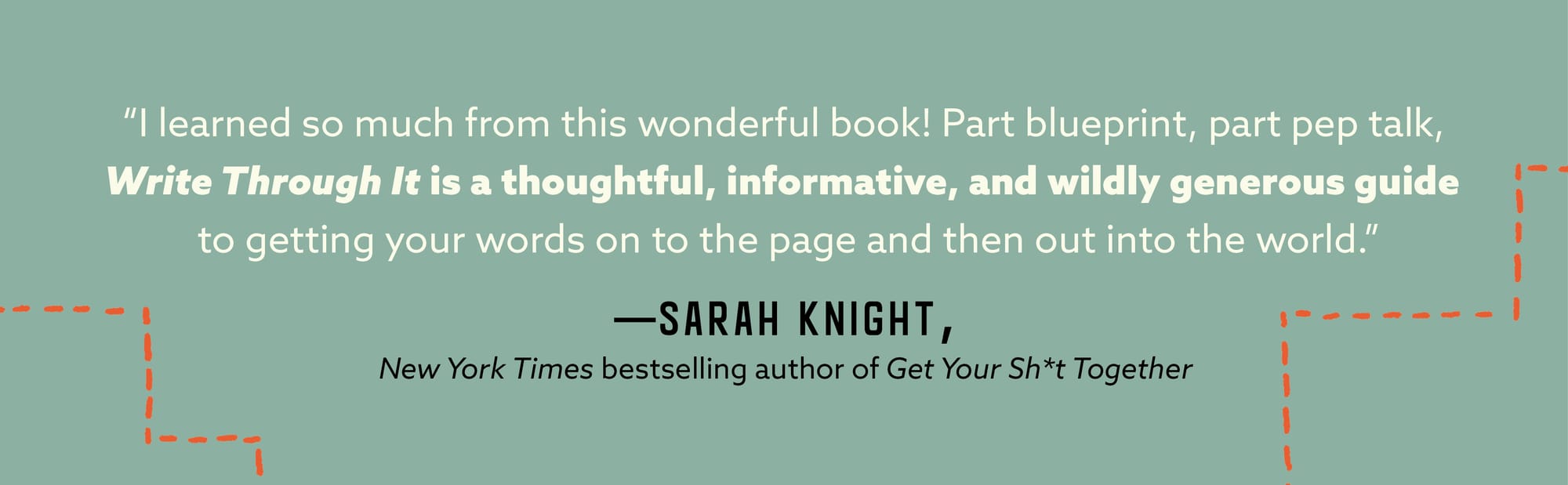
In traditional publishing, publishers use blurbs to promote a book. They go on the cover, of the galley and/or the finished book, in sales materials to the internal sales team, wholesalers, retailers, booksellers, etc, and to the marketing and publicity team for all their purposes. Blurbs go online on retail sites (on Amazon, that's called A+ content, and I know you've seen that with all the pull quotes from reviews and stuff.) You and/or the marketing team can make social media graphics like this one:
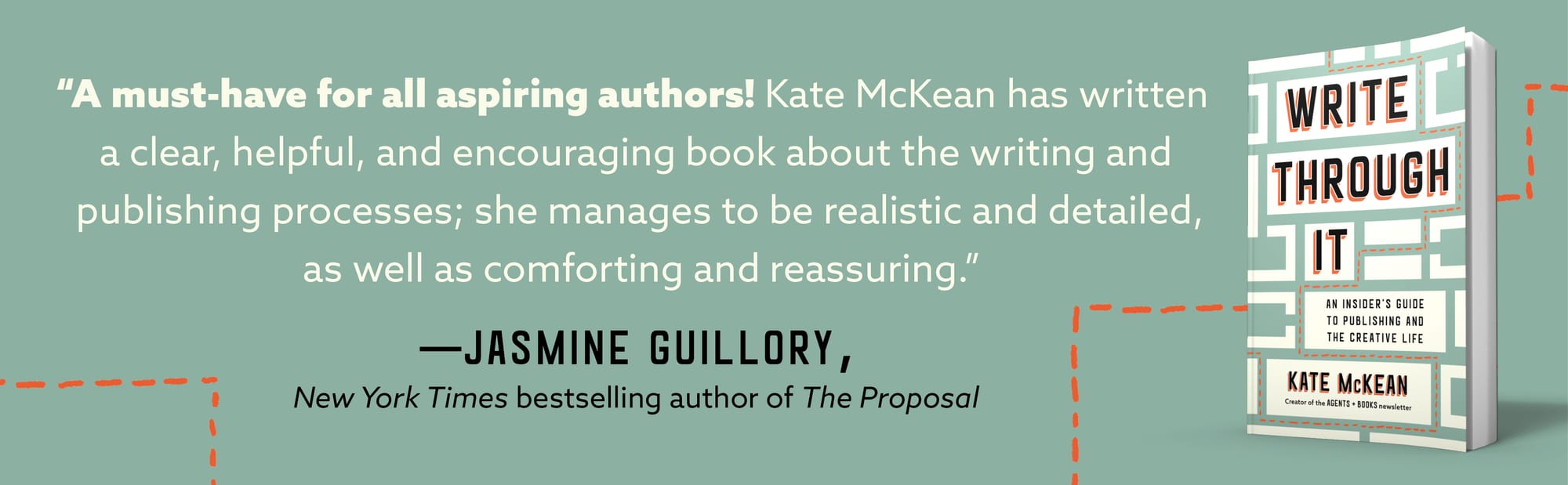
that you can use for years after your book comes out. All these are useful beyond the first few weeks before and after your publication date. Blurbs are forever.
What about blurbs before you sell the book?
I call these pre-blurbs, but I'm sure other agents have other names for them. Sometimes it can be useful to provide agents and editors with blurbs for your book before you even sell it. These come about the same way they do after you sell the book and sometimes they can really help. But it depends on A: the book you're trying to sell and B: who offered the blurb. If you're looking to employ this tactic for your own book, the most important thing to consider is the relation of the blurber to your subject matter, i.e. a blurb from Stephen King on a cupcake cookbook probably won't help much. I mean, maybe! But you see what I mean. Your MFA professor might be a famous writer of literary fiction, but her blurb for your regency romance might not hold the sway you think it will. Do not reach for pre-blurbs just for the sake of having them. A pre-blurb has never turned a No into a Yes for me. They are mostly an indicator of who is in your professional network, which can be useful for publicity down the line. It is a feather in your cap, not a must-have.
Who asks for blurbs?
Everyone: you, your editor, your agent. Your editor will likely send around an email saying something like who are we thinking of for blurbs? If it's your first book, you might have absolutely no idea who to ask, and that's ok. You should still think about it, though. Whoes books do you love that are similar to yours? Who are your comps? Who are your dream blurbers and also who do you know, either personally or even on the internet? There cannot be too many entries on the potential blurb list. Only a small percentage of those you ask come back with an actual blurb, so you have to overshoot the mark. The very worst thing that will happen when you ask for a blurb is the writer says no, and that's ok. Most of them will say no, and it isn't because your book sucks. It's because people are busy. Your agent will suggest some people they know. Your editor will do the same. You'll likely split up the list according to who knows who better, and send out your asks and see what comes back. Get ready to look at some shared Google Spreadsheets!
How do I ask someone to blurb my book?
You suck it up and ask!! I'll share an example below, but yes, it takes courage and confidence to ask a nice person to say nice things about your book, for free. It's important to remember asking for blurbs is a part of the business, not a herculean trial foisted upon your shoulders alone. It's a normal, everyday thing. If the writer you're asking cannot blurb your book, for any reason, they will say so. It's not an insult, to ask or be asked, to accept or decline. It's a professional courtesy. I coach my authors all the time to say yes if they can and no if they cannot. In general, you're in charge of asking and the recipient is in charge of saying yes or no and that's all you need to worry about.
An example of a blurb request email:
Here's the actual email I sent to the lovely people who blurbed my book, Write Through It.
Dear <name>,
I hope you're doing well! I come asking if you'd consider blurbing my book, WRITE THROUGH IT: A Insider's Guide to Publishing and the Creative Life, based on my newsletter, Agents & Books. My goal in writing both the book and the newsletter has been to make the ins and outs of publishing more accessible to writers, but also to let them know they're not alone. We both know how confusing writing and publishing can be, and what a difference a gentle hand can make.
WRITE THROUGH IT is organized roughly in order of how the reader will need the information, starting with their (mostly) finished manuscript, through to their end result–whatever that is. Besides tips on writing query letters and how advances work, I wanted to include information about the feelings side of writing and publishing. We all hate query letters. We all think our first drafts are shit. We all want the process to be quicker and easier. Writing and publishing can be so solitary–even with a team behind you–and I wanted writers to know everyone else feels the same way they do. I hope I've succeeded.
Thank you for considering lending your voice to support my book. Attached is the uncopyedited manuscript. It would be wonderful to have word back for the galley by 11/11, but later is also fine for subsequent promotion. Thank you again for your time, and I hope to see you soon!!
If you need anything else please don't hesitate to reach out. Or if it's useful, you can reach out to any others on my team, info below.
<emails of editor/agent/publicist here>
All best!!
Kate McKean
See, not that complicated. The most important parts of this letter are the date you want the blurb back, what the book is about, and the current manuscript format. In this case here, all I had was a digital file of the manuscript, not a printed galley or manuscript. It's possible that if a reader wanted an Advance Bound Manuscript (ABM), literally a manuscript printed out and bound at like Staples, my publisher would have gotten it to them. I could offer readers a Word doc, a PDF, and probably an ePub file, and all they would have needed to do was ask and I'd gotten them what they needed. If I were to add anything to this letter (besides the typo I just caught whoops) it would be to clearly state the formats I could provide the reader. My goal would have been to make it as easy as possible for them to read.
What DON'T you need in a blurb request?
You don't need to fall on your sword and beg forgiveness for having the audacity to ask someone do something nice for you. You don't have to walk on your knees for a hundred miles through the desert repenting. You don't have to be self-deprecating, dismissive of your own work, or spend an inordinate amount of time reminding the person how busy and important they are. I know you want to do all those things in your letter because asking for something is hard and vulnerable, but that is for you and this letter is for them. Take care of your own feelings off the page.
This whole thing sounds like a racket and is just asking writers for free labor. I hate it.
You're not wrong! It is asking for free labor and hinges on the kindness of professional acquaintances and paying it forward. You blurb (if you can) because someone did it for you. ¯\_(ツ)_/¯ You might not have to do it. Not all books get blurbs. My picture book didn't and we didn't solicit for them, afaik. For my non-fiction book, blurbs were much more important and I am eternally grateful for the ones I got. One day I will blurb a book and the circle will be complete. I've asked dozens and dozens of authors to blurb my client's books. Ad infinitum. If you want to opt out of this on principle, sure. Your publisher will probably want to do it on your behalf anyway. But don't opt out because you're scared. Everyone's scared! And if the reader doesn't like your book, they're not going to write you a bad blurb! It'll be ok and it'll be over soon. Until your next book.
What if I'm asked to blurb a book?
Congrats! Someone thinks your name and/or thoughts will help sell a book! The first thing you should do is consider whether you want to read the book or not. You don't have to just because you were asked. If someone misread your book Dragons Are Bad and sends you a book to blurb called Dragons Are Good, Actually, you don't have to read it! You can just say no! "Gee, I'm busy at the moment, but thank you for thinking of me!" is a perfectly sufficient response and no one is going to ask you for more detail. If you start reading a book and it turns out that it is Not For You, you can politely decline even after you said yes. You can say, "Unfortunately, my schedule changed and I'm unable to offer a blurb now. So sorry about that. Best of luck!" and no one is going to ask you for more detail. Better yet, you can have your agent write that note! Us agents are happy to send the hard emails for you, and we've done it hundreds of times before. No one is going to tell the author gee, Suzy Writer over there hated your book. Never ever ever. If you read the book and you like it, say whatever you want about it. Say what you as a reader would find useful on the back of the book. I like blurbs that focus less on plot and more on vibes. How did reading this book make you feel? How did it make you feel in the end? How do you think about it now that you've read it? This is one place to start, and if you're still stuck, talk to your agent/editor about it. They'll help.
I hope this helps, friends. Try not to stress too much about blurbs, whether you're doing the asking or the blurbing. It's just one small part of the big publishing machine, for better or worse.
To steal a line from New York Magazine newsletters, click your way out:
Want to ask a Q&A Thursday question? Great! If you're a paid subscriber, you can fill out this form. If you're not a subscriber yet, mash that button down below. No question is too big or too small!
XOXOXOX,
Kate

Who am I and what is this? This is Agents & Books, a twice-weekly newsletter about writing, publishing, and the creative life. I've been an agent for 20 years, most of it at the Howard Morhaim Literary Agency, and I'm the author of two books: Write Through It: An Insider's Guide to Publishing and the Creative Life (Simon Element, 2025) and a picture book called Pay Attention to Me!, with illustrations by Rob Justus (Sourcebooks, 2026). If you haven't already, become a subscriber today. $5 a month or $50 a year. Same price since 2019! Need to cancel? Look here.

Comments ()