
20 Things I Learned From 20 Years as an Agent
Happy Anniversary to me. And a Giveaway!
Hello friends!
Thank you to everyone who's signed up recently from our sale and new subscriber perks. I’m so glad you’re here. Below, I will announce the winner of the FIRST EVER Agents & Books book giveaway! I love being the book fairy. It‘s an exciting day here at A&B.
But, besides all that, I had a great time celebrating my 20th anniversary of being an agent at the Howard Morhaim Literary Agency last week. Twenty years!? Honestly, it's gone by in a flash. To mark the event, I'm going to share 20 things I've learned in these last 20 years with you. In no particular order:
So goes the proposal, goes the book.
If it's like pulling teeth to write or edit a book proposal, writing and/or editing the actual book will be just as hard. There's the normal amount of hard that all writing projects are, and then there's the straining for every word, being unable to articulate the hook/pitch, struggling for comps. And that's a sign. The same goes for novels, but what constitutes hard is much harder, lol.
If you can’t tell me what your book is about, then a reader can’t tell their friends why they should read it.
The pitch is not just there to hook an agent or editor. It travels all the way down the book consumer chain to the reader you want to pick up your book in a store and take it home. If you can't tell me what your book is about, I can't tell anyone else.
Managing expectations is the path to publishing happiness.
I'm sure you remember what you originally thought writing and/or publishing your book would be like. Words flying from your finger tips, an agent in 4.3 seconds after querying, six figure deal, etc. LOL. Knowing that all of this is hard for everyone all the time will make your experience much more enjoyable, trust me.
Nobody knows what you want until you say something.
If you don't understand your contract, no one knows unless you say something. If you hate your title/cover, no one knows unless you say something. If you thought X would happen and it didn't, no one knows you're confused unless you say something. Having questions for your agent or editor is normal. Ask them!
Literary doesn’t always mean high quality. Commercial doesn’t always mean dreck.
The definition of a "good" book is wide and ever changing. Calling a book "literary fiction" doesn't mean it's automatically a "better" book than something labeled "commercial fiction." Don't be a snob. Read what you like.
Trends are over as soon as you know about them.
When you see a trend on a bookstore shelf, that means that book was sold 1-2 years ago, and written 3-5 years ago, and hit an agent's desk somewhere in between. If you start writing a book to a trend when you see a bunch already published, you're up to five years behind the curve.
Kids don’t want to read a book that aims to teach them a lesson. Did you when you were a kid?
Can kids learn life lessons from reading books? Duh, of course they can. But they can also sniff out a book that feels or sounds like school in a hot second. Have respect for kid readers.
Picture books are the hardest books to write.
Everyone thinks they can write a picture book (me included). But just because they're short, doesn't mean they're easier to write. In fact, they're much, much harder. Each word has to be perfectly placed and work in concert with illustrations that might not even exist yet. And be new and interesting. And appeal to kids, parents, booksellers, teachers, librarians. It's a tough needle to thread.
No one throws a parade when your book comes out.
Your publication day is very special to you, and your agent and editor and the people who love you. But you won't wake up a new person on that morning. Your jeans won't fit better and your teeth won't be whiter. There will not be a crush of reporters at your door. Prepare yourself for this, and lead the celebration yourself.
Vibes matter, with agents, clients, editors, and books.
When something doesn’t click–a writer's voice, a conversation with an editor, a plot resolution, a first call with an agent–that matters. And the vibes don't get better by sheer force of will. If you feel the vibes are off in any publishing situation, talk to the relevant parties, even if it feels awkward or hard.
Publishing professionals don’t have any magic tricks to spot best sellers or make people buy books. We just have experience.
Editors, agents, and publishers are not hiding the secrets of success from you and we can't unlock the magic marketing plan when it's your turn. We don't have secret mailing lists of the perfect buyers of your book or ways to ensure that you'll get on the List. We just have experience, know what's worked in the past, and what we might try to do again to see if it pans out. Because you, as a reader and buyer, cannot be forced to buy a book by a publisher or writer, can you? You can only be made aware of it in the most compelling way possible And then YOU decide what to spend your money and attention on. It’s works this way whether you’re the reader or the writer.
No platform + great book is as hard to sell as big platform + mid book.
As an agent, I find it just as hard to sell a good idea by an unknown non-fiction author, as I do selling a meh idea by an author with a huge platform. Sure, a well-known author will get attention, but if the reader doesn't see a reason to actually own and read the book, they won't buy it just because a person is famous. Or the truefans will buy it the first week and then reader reviews will be weak and that excitement will fizzle out. In the same way, if the publisher has no way to directly get to an author's fans (and remember those secret mailing lists don't exist) then a good idea will die on the vine.
Reaching The New York Times best seller list is akin to being discovered by a modeling agency on the street.
Ahh, the List. Everyone wants to be on the List. But so, so, so few people will get on it. You do not have to hit the list to have a successful career. Just ask all the hundreds of thousands of authors who never have.
The harder the conversation, the more it needs to happen.
The more you don't want to ask the question, raise the issue, voice your discontent, the more you really actually have to do those things. Every time I've avoided a hard conversation because it was hard, I've regretted it. These things are hard in the moment, but I promise you will not crumble into dust by doing it. You'll feel better after, I guarantee, whatever the outcome.
Someone will get the thing you want and if you let it fester in your soul you will ruin your own writing practice and career.
You will not get everything you want in your publishing career (this applies to us agents and editors, too!). You're going to watch someone get some thing you think they don't deserve, too. These are guarantees in your career. If you focus on this, it will eat away at your soul and make this whole endeavor a horrible chore. Save yourself. Comparison is the thief of joy.
No one deserves a book deal like no one deserves a record deal, a magazine cover, or a starring role in a movie.
Your story may be hard-won, harrowing, enlightening to the masses, or the result of years of struggle. It might change the world if only people would read it. But that doesn't mean you or anyone else deserves a book deal. They are not medals given out for hard work. They are a business deal between a publishing company and an author. Don't confuse the two.
The only way to make it in publishing is to write another book.
You know how your favorite author built their career? They wrote another book. They probably wrote many you don't even know about before the one that got published. They have probably even written ones in between their blockbusters that didn't work or didn't get published. Shocking, I know! One book deal does not open the door to infinite book deals thereafter. You have to basically start anew with each one.
How you personally choose books to read is insight into how you can market and sell your own book.
How did you find out about that author? Where did you read about that new novel and where did you hear about that new cookbook? How did you choose between one book and another on the same topic in the store? What made you excited to read that debut? How did you know that new book everyone was talking about was, or was not, for you? The answers to these questions will help you pitch and sell your own book, and even build your platform.
You don’t have to write a book.
You don't have to write a book about that remarkable or terrifying or notable thing that happened to you. You don't have to monetize your trauma. You can want to, you can try, but just because you have a good idea (however you define that) doesn't mean that it belongs in a book-shaped container and/or that there's a reader on the other end of it and/or you have the skillset or resources to make it into a book. And that's ok.
You don’t have to publish a book just because you wrote it.
You can write a book for the sheer pleasure of it. You can write a book, decide at the end that it isn't what you want to put out in the world, and try again with something else. You can write the first half of six different books and call it a day. The ultimate expression of a book is not traditional (or even self-) publication. It doesn't have to be published to have value, to you or anyone else.
Some of these things won’t apply to you. (That’s lesson #21.) Take what you need and leave the rest. You’ll need some of this now and some later, no matter where you are in your career. Now you know (just about) everything I know. I hope it helps.
Here we go! Our first ever book giveaway! All subscribers in good standing to Agents and books are entered to win our monthly book giveaway. You'll have a choice between several genres and next week, I'll reveal what the lucky winner chose! This week we're choosing between:
Kid's Non-fiction!
New Literary Fiction ARC!
Hot and Spicy Historical Romance!
And the winner is Bridget Watson! I'll send you an email and we'll sort out your book!
Want to be in next month's drawing? Make sure you're a subscriber. And tune in Thursday when I'll announce the winner of our first ever query/first pages critique giveaway, open to paid subscribers!
XOXOXOOXOX,
Kate
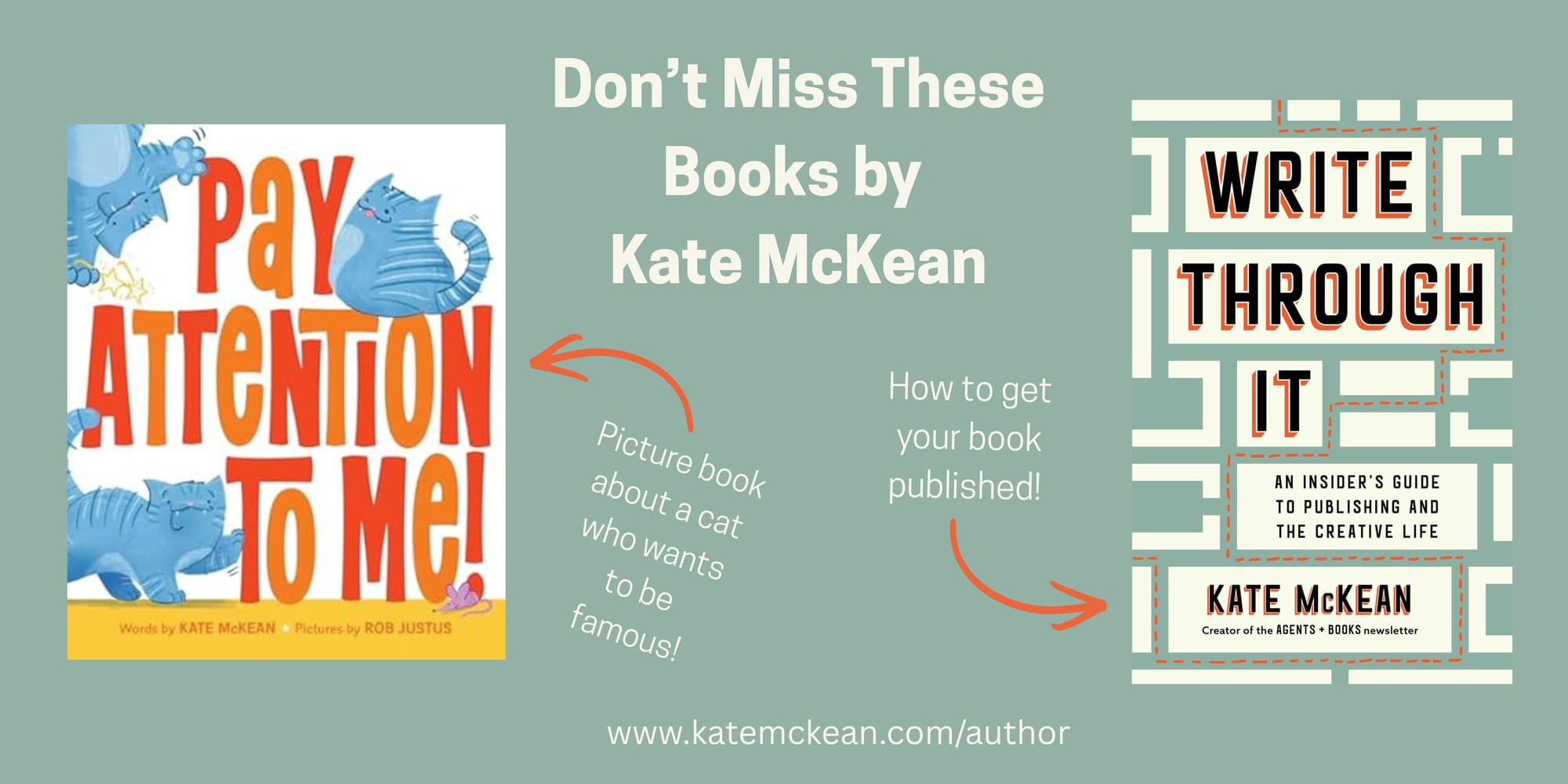
Who am I and what is this? This is Agents & Books, a twice-weekly newsletter about writing, publishing, and the creative life. I've been an agent for almost 20 years, most of it at the Howard Morhaim Literary Agency, and I'm the author of two books: Write Through It: An Insider's Guide to Publishing and the Creative Life (Simon Element, 2025) and a picture book called Pay Attention to Me!, with illustrations by Rob Justus (Sourcebooks, 2026). If you haven't already, become a subscriber today. $5 a month or $50 a year. Same price since 2019!



Comments ()